|
||||||||||||||||
 |
 |
|
||||||||||||||
|
|
|||||||||||||||
|
“What’s the nature of the place? The proper approach to any kind of land use begins with that question. What is the nature of this place? And then: What will nature permit me to do here? What will nature permit me to do here without damage to herself or to me? What will nature help me to do here?” - Wendell Berry |
Two Breath Meditations
Here are two breath meditations to explore. The first is performed in a chair; the second, lying on the floor. You can read them here to yourself. You can also purchase guided meditations on the Products page. Have a good journey, and enjoy your breath! Three-dimensional Breathing Sit comfortably in a chair. Start by checking in with your deepening breath, a rising spine and an easy jaw. The fullness of the breath in the belly helps stabilize your pelvic bowl, as your center of gravity descends. This stability creates the foundation for your spine to extend upwards effortlessly. The back of your neck rises as the front of your face eases downwards and the lips open slightly to let your jaw soften. Begin by focusing on the vertical dimension of breathing - up and down. Extend the duration of your inhale to fully feel the length of this dimension. With each breath, your diaphragm presses down towards the pelvic floor, towards your rectum, and with each exhale, floats back up towards your heart. As you sense your diaphragm moving down on the inhale, your lungs are filling up. Each inhale lengthens, each exhale shortens (not collapses) the verticality of your body. Do this for about 10-12 repetitions, and then move into open attention, allowing your body to settle into its own breath expression. Notice what is happening internally during this effortless, receptive awareness. Now, focus on the sagittal dimension – the forward and backward. Start with your belly. With each inhale, focus on your belly swelling forwards and your lower back swelling backwards simultaneously. On the exhale, both belly and lower back recede to the centerline. Do this several times. As you continue the fullness of your inhale, begin to include awareness of your upper body: your chest moving forward into space, and your back extending into the backspace. Do this for about 10-12 repetitions. Then, shift into open attention once again. Now, focus attention on the horizontal dimension – the movement sideways. Begin by noticing the opening of your ribcage out to the sides with each inhale, and then closing back in on each exhale. As you settle into that action, begin to include awareness of your pelvic halves opening and closing laterally at the sacrum. And finally, add your shoulders and shoulder blades widening and narrowing with each breath cycle. After some time, return to open attention. Finally, bring all three dimensions into action simultaneously. Repeat for a while, and periodically return to open attention, creating a rhythm between purposeful action and spacious rest.
The 4 Diaphragms Begin by lying down on the floor. Rub the palms of your hands together to generate heat, and lay the heels of the hands down in your eye sockets as the fingers spread out on the skull. Let the heat from the hands soak down into the eyes, refreshing and soothing them. Breathing in through the nose, and out through the mouth. Each breath you take expands the skull bones a tiny bit, creates a ripple through the supporting brain fluids and the tissue. Now, let the hands slide down to the upper chest, feeling the hands rise and sink on each inhale-exhale cycle. Focus on the movement of the breastbone, or sternum. Empty out fully to create a valley; inhale fully to create a ridge. The breath is the movement of life, generating new landforms, wave motions, frequencies of thought, feeling and perception. Now, bring the hands down to the sides of the ribcage, where the ribs open out to the side. In your right hand is the lower lobe of the right lung and the liver; in your left hand, is the lower lobe of the left lung, and the stomach and spleen. With each inhale-exhale cycle, notice the lateral movement of the breath, moving out to the sides on the inhale, and coming back to center on the exhale. Begin to stretch your capacity to inhale in this dimension by extending the duration of the inhale beyond your ordinary range...and then let it go, lingering in the emptiness after the exhale until the next impetus to inhale arises. Now, let the hands slide down to the belly. With each inhale, notice the roundness and fullness of the belly as it swells and rises to the ceiling and simultaneously spreads out on the floor. With each exhale, feel the belly condense. Inhale-exhale... Now, pay attention to the depth of the sustained inhale as it presses downward into the pelvic floor, all the way into your genitals and rectum, and then let it go. There is a bit of a rebound, like waves lapping up against a seawall, and then drifting back out. Feel into the rhythmic flow of this action. Once again, extend your capacity through extending the duration of the inhale cycle to its maximum occupancy. Now, bring together the four places of the breath by conscious attention to the unobstructed flow of breath from belly to pelvis - ribcage - chest – skull. Maximize the fullness of the torso on the inhale cycle and the emptiness on the exhale cycle. Experiment with this for at least six breaths. Now, let go. Let the body breath itself in its own way. Rest in the movement of the breath, passing in and out, fluid and easy. Copyright 2002 by Jamie McHugh. All rights reserved.
|
|
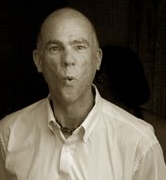
Jamie McHugh. |
|
||||||||||||
| © Copyright Jamie McHugh. All rights reserved. About Jamie | What Is Somatic Expression? | Courses | Calendar | Somatic Expression Articles | Somatic Expression Links | Products | Contact Jamie McHugh | Home |
||||||||||||||||