|
||||||||||||||||
 |
 |
|
||||||||||||||
|
|
|||||||||||||||
|
"You are an element of nature living in an unnatural environment and require proactive tending. Daily use of the five technologies and nurturing your inner ecosystem is essential; making time for practice creates a regenerative oasis in the midst of the hurly-burly modern world." |
Somatic Expression - Learning Nature's Languages
Somatic Expression is an easy, pleasurable and creative way to learn about your body and its expressive potential. A primary intention of this work is to befriend your body and make it your ally instead of your nemesis. Rather than dominating or forcing your body to perform in a pre-programmed way, you collaborate with it and focus more on the pleasure and creativity of your body in motion as children do rather than on what you look like or what you are accomplishing. And instead of whipping yourself into shape to fulfill a goal, you let health benefits accrue naturally by consistently working - and playing - from the inside out with curiosity and ease. This is a new paradigm for physical education and exercise – being a body of nature in motion rather than a goal –focused machine. In this approach, you are guided through the inner landscape of your body to explore the preverbal technologies of breath, vocalization, contact, stillness, and movement. These preverbal languages are actually not so foreign - we automatically use them all the time unconsciously. When we hurt, we instinctively touch ourselves. When we feel tired, we yawn. When we are trying to figure something out, we pace. These reflexive actions can be evoked consciously and deliberately if you understand their purpose and become literate through experiencing. For example, yawning disperses the buildup of tension by releasing the muscles of the diaphragm. So don't wait - go ahead and yawn when you feel tense and see what happens! Walking processes information by using the early motor cross-crawl pattern of right and left-brain integration. So, when you feel stuck, simply go for a walk. Learning the five elements is both experiential and didactic, as understanding your body’s design and needs creates a motivating context for practice. For example, proprioceptors are the sensing mechanism in muscles that report on the degree of tension or relaxation as well as where your body is in space. When muscles are habitually tight, you cannot get an accurate reading from your proprioceptors. As the choreographer Erik Hawkins always used to say, "A tight muscle cannot feel". With fifty percent of your proprioceptors located in your head and neck, you deprive yourself of a lot of sensory feedback when your head is tied up in knots. Excessive neck tension inhibits the flow of blood and oxygen to the brain, and limits the brain’s functioning. Imbalances in the position of the skull on the top of the spine contribute to postural distortion, resulting in maladies such as back pain and headaches. You are an element of nature living in an unnatural environment and require proactive tending. Daily use of the five technologies and nurturing your inner ecosystem is essential; making time for practice creates a regenerative oasis in the midst of the hurly-burly modern world. It helps generate an inner dialogue so you can hear and understand more readily what your body is trying to say to you. When you stimulate the sensory feedback process and get a clearer inner reading, you know how to respond. This conversation between bodily listening and response is a fundamental intelligence as somatic literacy gives you choices and solutions through informed experience. Generate more sensation through self-contact, small movements, or sound vibration to wake up your proprioceptors! Rub your scalp and tap the back of your neck to generate more circulation and warmth in your tissue. Move the skull on your atlas (the very top vertebrae which is in-between your ears). Circle in one direction with the inhale and in the other direction with the exhale. This helps fine-tune the subtle balancing of your skull. Breathe out through your mouth to ease tension patterns in your jaw and breastbone - we all have something to "get off our chest". Using these languages stimulates and awakens more self-awareness, so they are as much for self-mastery as they are for preventative health care. You then have the power and wisdom to change moods, pain, and anxiety through self-initiated somatic dialogues. Practice creates incremental change over time, gradually transforming the nature of your body and how you feel about yourself. And by learning to live comfortably and securely in your own skin, you can endure the anxiety of change and the constantly shifting weather of thoughts and moods. As the bumper sticker proclaims, "It is never too late to have a happy childhood". So, enjoy your body as a child does – freely, sweetly, and simply – as you play for health, and heal through play. Selection from “Restoring Original Grace: Movement as Medicine,” a work-in-progress by Jamie McHugh. All rights reserved. |
|
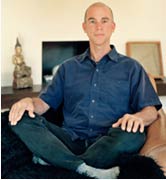
Jamie McHugh. |
|
||||||||||||
| © Copyright Jamie McHugh. All rights reserved. About Jamie | What Is Somatic Expression? | Courses | Calendar | Somatic Expression Articles | Somatic Expression Links | Products | Contact Jamie McHugh | Home |
||||||||||||||||