About Jamie What is Somatic Expression? CalendarPhotography Somatic Expression Articles Somatic Expression Links Somatic Expression Products Contact Jamie McHugh Home Page

“These five elements are concrete reference points, serving as gateways into the body that allow the pre-planning mind to relax more into the moment and follow the spontaneous action of the body. This learning to let go into sensation, and moment-to-moment awareness, enables self-consciousness to temporarily drop away so something else can emerge.”

The Five Elements of Somatic Expression

I have been teaching movement-based work in different forms for the past twenty-five years. During this time, I have have accumulated many techniques and tools from diverse bodies of work for working with the body somatically and expressively. For many years, students of mine had encouraged me to write and make more explicit my knowledge base and way of working. Five years ago, I finally set off on an extended sabbatical to examine what I had learned, what I had taught, and what I actually believed I had to contribute to the world of somatic movement education and therapy.

The combination of living by the ocean and my immersion into a world of solitude, reading and writing initiated me into a process of self-reflection and radical revision of my work. I began to ask some primary questions: What does nature implicitly give us as human animals? What technologies are already hard-wired in our systems for health, well-being and pleasure? And how can we remember and activate this inherited vocabulary consciously?

As I sifted through what I knew, and what other theorists of Somatics were teaching, I identified five natural technologies of the body. These five elements are:

  • breath
  • sound
  • touch
  • movement
  • stillness

After I identified these elements, I turned to the questions: What do I see as the foundational skills of bodily awareness and expression? What activities are most relevant and accessible for a majority of people? I realized my particular gift was synthesizing various Somatic approaches into these simple five element practices. By differentiating these elements and examing them individually, they could then be woven back together to be used in combinations of greater complexity. In this way, people could simply use the practices in their daily lives as a form of refuge and regeneration for five minutes at a time, or they could use them for more in-depth inquiry and expanded states of consciousness.

These five elements are concrete reference points, serving as gateways into the body that allow the pre-planning mind to relax more into the moment and follow the spontaneous action of the body. This learning to let go into sensation, and moment-to-moment awareness, enables self-consciousness to temporarily drop away so something else can emerge. Through the body in motion, you are able to explore and increase your range of choices for feeling, perceiving, thinking and sensing as you move from from self-consciousness to self-awareness.

Here are the ways I am defining and looking at these five elements.

Breath is a primary movement of the body. One of the first movements of life is respiration. Breathing is both involuntary and voluntary, a bridge between the automatic and the chosen. Involuntary breathing is controlled by moving, thinking and feeling. You can change your mind to change your breath, or you can voluntarily change your breath to change your mind. As such, breath practices are the key to self-regulation. We can stimulate or sedate ourselves through the shaping of our breath. For example, habitual shallow breathing deprives the body of sufficient oxygen and stimulates the sympathetic nervous system (the fear response). Similarly, chronic fear automatically creates shallow breathing. By breathing consciously, you can interrupt the habit and change inner perception, rhythm and response.

Breathing is not for oxygenation alone. The movement of full, uninterrupted breathing (three-dimensional) supports organ tonification, vascular pressure regulation, digestive peristalsis and lymphatic flow.

Breathing is also a barometer of your changing inner weather. Any disturbance of functioning - physically, mentally or emotionally – alters your breathing rhythm. Breath can be thought of as the “good mother” of the body, as basic reassurance is evoked through the inner touch of your own breathing. By placing attention on your breathing, you are able to feel your core and the pleasure of your own being.

Breath practices in this approach consist of variations in articulation and duration.

Sound is the exhale made audible. Sound forms the exhale and uses different muscle groups throughout the torso to create more flexibility in the central diaphragm. Vibratory sound, or toning, transmits vibration through the bones to stimulate micromovements in the muscle attachments. These small pulsations of the muscles both relax and energize the body by awakening proprioception. Vibratory sound also charges the brain’s energy, balances endocrine function, and helps with pain management.

Sound is a reflection of, and a catalyst for, the emotional body. Your tone of voice communicates your feelings because the auditory channel is a direct pathway to the limbic brain (the part of the brain that registers feeling). Sound brings you out into the world and makes you visible. You cannot hide your internal state when you are freely making sound! Pre-verbal sound expression is the precursor to language and, as a somatic practice, can give you the confidence and support for expressing yourself verbally. As such, sound can be thought of as the “good father” of the body as it helps you move out into the world.

Sound practices integrate the breath and the voice through the exhale. Practices in this approach include basic expressive breaths, aspirated sounds (those beginning with an h), toning, chanting, singing and speaking.

Movement is human intelligence moving through pathways of nature, of culture, and individual meaning. Movement first connects us to all life-forms. The human body is bio-morphic, a biologically-based process with a hard-wired repertoire of movement. Flexing and extending, pushing in and reaching out, pulsating and radiating are some of these basic movements. This design is with you at birth; infants in all cultures proceed through the same developmental stages. These basics are the origins of more complex motor behaviors as well as reflections of neurological organization, slowly unfolding and evolving depending upon your environment in the early years. Neurological and motor development are simultaneous processes. Infants learn movement as a dialogue internally with themselves and a externally with their environment. These dual processes incrementally increase the complexity of their motor action, sensory awareness and cognitive ability.

Movement is not something new you need to learn but something old that needs remembering. By reactivating these early foundational patterns with conscious awareness, you are able to create a bridge between the instinctive and the refined. This creates more connection and dialogue between the reptilian brain and the neo-cortex. Movement in this approach traverses the spectrum from primitive reflexes to complex motor behavior. What does nature give us as human animals? And how do we build upon this template as aware beings?

Another aspect of movement is postural alignment. Alignment is the attention to balancing the bony structure of your body by collaborating with gravity for more inner ease and efficient functioning. In sitting, you attend to the dynamic relationship of your skull, rib case and pelvis through the centerline of the spine. In standing, which is more complex, you include your feet and legs in awareness. How you align yourself impacts proprioceptive feedback and body image, generating more stability, mobility and ease in movement.

A final aspect of movement is the expression of inner impulses reflecting your individual uniqueness. Unconscious body language tells its own story in postures and gestures, reflecting your inner self narrative. Conscious expression brings the narrative forward and out into the open, where it can be witnessed, explored, and appreciated. This is movement as metaphor and meaning, your own personal dance that can unfold and guide you through your own body wisdom.

Movement practices in this approach include basic developmental movement patterns, alignment activities, and personal movement expressions.

Touch brings us back home to ourselves. When people talk about being “out of touch” with their bodies, they are not just speaking metaphorically. Touch is a tool for directly feeling ourselves. Wherever you touch or are touched, your attention follows. The tactile sense illuminates body image (the felt visualization of where our body begins and ends) through proprioception. The use of intentional touch, either self-touch or in partnership, is a way to be in contact with ourselves and one another.

Touch stimulates self-awareness, increases sensation and re-enforces body connectivity. Touch receptors are also a direct pathway to the limbic brain. Self-touch is a form of self-soothing and basic reassurance, creating the conditions for your organism to be more open and less defensive. Self-touch is also a way to practice bodily acceptance, counteracting the taboo against self-love and pleasure. Touch practices in this approach include directing, targeting, hovering, tracing, compressing, supporting and pulsing touch.

Stillness tunes us in to subtle dimensions of being. Stillness for the reptilian brain is connected to fear, as the function of fear is to stop movement. Voluntary stillness stops movement without fear, creating the conditions for reflective awareness. Stillness builds sustained attention for sensing, feeling and perceiving. It is a form of punctuation, modulating the flow of our thinking and moving. Stillness can be as short as the pause at the end of the exhale, or as long as a twenty minute meditation.

We are never truly still. But we can approximate finer and subtler degrees of the still point in ourselves. In stillness, we learn to listen, receive, attend and rest. Stillness practices teach the organism how to just be. Practices in this approach include various meditation models, kinesthetic imaging of structural or energetic flow, and “open attention” (systemic somatic awareness throughout the body). 

Introductory Five Element Activities

“Sensuality is a form of giving up: of our goals, hopes, agendas for the next five years or minutes. A surrender of our purposeful, planned, caretaking, self-improving personas to the sheer presence of the world. Being sensuous means being endowed with senses, and that taking pleasure in them is enough.” – Jon Spayde

The following activities each require about ten minutes. You may want to try all of them a bit right now for a few minutes only to get an overview, and then go back and repeat one each day.

The intention of each activity is to experience what is happening at a direct, experiential and sensory level before you evaluate the contents. When completing an activity, or before a transition, give yourself a period of “open attention”.

Open attention is a relaxed stillness and silence with effortless focus. Let your mind scan the whole body internally and notice what is alive in you NOW. Open attention is a way to harvest the benefits of one’s action by resting in the aftermath of the activity. It is also a way to become aware of what is trying to emerge from the emptiness.

A major distinction between this approach to the body and ordinary exercise and movement is the attention to your sensory feedback: how the activity makes you feel, perceive and sense yourself. Punctuating the flow of activity with stillness is a crucial ingredient in feeling these changes. By taking the time for “open attention”, you gather sensory information stimulated by the activity. After gathering, you assess the information arising from open attention:

  • What did I discover about myself?
  • What type of information did the activity give me?
  • What has come to the foreground of awareness?
  • What is alive in me now?

These questions are wide-open to invite awareness of your personal experience. You might have more access to thoughts, or to feelings or sensations, or to perception. And, of course, there is not only the experience in and of itself, but also the overlay of your personal reactions to the task. For example, were you concerned about doing it right or wrong? Did you need to know the outcome ahead of time? Did you enjoy this inner attention or did it make you anxious?

Both awareness of your inner experience and acceptance of whatever you discover are fundamental in this approach. We are collecting sensory data for ourselves with the intention of opening to our experience as it is, so we can make a change if so desired. “Everything is perfect, and there is always room for improvement.” This Zen saying is a good motto for our inner inquiry. The feedback will probably be hard to notice at first; it might even feel like you are not accomplishing anything!But with patience and increasing concentrated, yet relaxed, attention, your mind learns to notice more sensory feedback and appreciate it in and of itself.

Breath Activity

Begin sitting. Notice your position and how your body is arranged. Make any change that creates more support and comfort.

Now, shift your attention to your breath, noticing the inhale and exhale cycle. Where do you feel this movement? In the belly? In the chest? Do this for a minute, staying focused on this repetitive movement of breathing.

Now, make a change in your breathing. For the next minute, inhale through the nose and out through the mouth, closing the mouth before each subsequent inhale. Then, for the next minute, breathe in and out through your nose. Notice the difference.

Now, use either way of breathing, and focus on the following image for the next few minutes. With each inhale, your diaphragm (the 360 degree muscular sheath that divides the upper and lower body; it is the floor for the heart and lungs, and the ceiling for the guts) presses down towards your pelvic floor and with each exhale, floats back up towards the head. I use the image of a jellyfish; see what image arises for you. Repeat for a few minutes, and then come to open attention. Once you have read this, you might close your eyes for increased inner concentration.

Touch Activity

Take a moment to focus on your hands. Sense their surfaces, and imagine the receptivity of the nerve endings under the skin. Begin to touch objects in your immediate environment. Notice the different types of pressure that you can apply to each “touch encounter”. Do this for about five minutes. Now continue this exploration by touching yourself with various pressures. Do this also for about five minutes, becoming aware of how different parts of your body respond distinctly. At the end of this exploration, come to stillness and open attention.

Sound Activity: Hum

Sit comfortably. Bring attention to your breathing cycle. Begin to “hum” each exhale. Find a comfortable pitch you can stay with for the next few minutes. Notice how long the hum can last; and how you can vary the sound simply by making small facial adjustments, or by touching the tip of your tongue to your teeth. Also, place your hands on the upper bony structures - skull, breastbone, and ribs - to feel the resonance of this vibration. Come to silence and open attention, taking the next few breath cycles to notice sensation, feeling and thinking.

Large Movement Activity: Forward Flexion and Extension of the Spine

Begin standing. Take a moment to feel the contact of your feet on the floor, the breath in your belly and the rising of your skull up through the back of the neck. Let the chin drop into the chest as you let go of the weight of the head. Begin to curl the head in, like a fiddlehead fern, as you bend each vertebrae in a forward flexion. The head is moving downwards, its passive weight stretching the extensor muscles of the back. You will notice a certain point where your weight will move from the center of your feet towards your heels, causing the knees to brace and stiffen. Bend the knees so the legs can continue to get support from the ground. As you continue to articulate each vertebrae in the forward flexion, you will get closer to the ground. When the hands make contact with the floor, let them take some of your weight. Shift back and forth between your hands and feet. Take a few deep breaths into your lower back to create more space for the intervertebral disks*.

To reverse directions and come to extension, press your heels into the floor and begin to rise vertebrae by vertebrae. Let the head be the last part to arrive in extension. Repeat this sequence of flexion and extension three more times, so that you relax into the sequence. Keep focusing attention on your central line and the movement of your breath.

Subtle Movement Activity: Sitting Alignment

Get comfortable in your chair, either by settling back so that your lower back has support, or by sitting forward so that your feet are placed firmly on the floor. Use your imagination: Think down from the skull all the way through your centerline to the sitz bones, the two protruding bones that make contact between your buttocks and the chair. Rock back and forth from your hip joint until you find the center point of balance in sitting on your sitz bones. Come to stillness.

Focus on your belly moving in and out with each breath. Once you are connected to this awareness, turn your attention simultaneously to the length of the spine. Notice how each inhale creates a dynamic pressure internally that increases the verticality of your spine, and how each exhale relieves that pressure. This is a very small movement, so have patience. If you try too hard to concentrate, you will most likely start holding your breath and tightening your muscles.

Finally, shift attention to your skull. Focus on your atlas, which is the balancing point of the skull on the uppermost vertebrae at ear level. Make small “yes” and “no” movements with attention on your atlas. Notice how light and delicate this movement can be, with very little muscular effort. Bring your head back to stillness.

Sitz bones, belly, spine and skull: Check in with these reference points periodically by activating small movement. These tiny movements also create the conditions for settling into stillness.

Stillness Activity: The Waterfall

Sit comfortably and enjoy the movement of your breath. On each inhale imagine breathing up your back and on each exhale imagine breathing down your front. You can think of the exhale as water cascading down the front of your body. After a few minutes of conscious attention to this image, let it recede into the background as you enjoy “open attention”.

Purpose of the Five Element Practices

Each of the five elements of somatic experience - breath, sound, touch, movement, and stillness - contributes different sensory information to your organism. This varied information stimulates different regions of the brain, keeping the mind flexible which, in turn, keeps your organism flexible.

Various aspects of your psychology are also tapped in this process of using these five diverse elements. In stillness, one can disappear. This blending with the world can be quite powerful; it can also be a safe habit of withdrawal. Sound, on the other hand, makes one visible. You stand out. Perhaps you are emboldened to speak out. Sound, then, becomes a counterbalance to stillness. Similarly, stillness is a useful tool for people who are highly expressive, emotive or driven by “doing”. In stillness, you can experience more of your capacity just to “be”. “I am useful...still” can be a powerful experience for those driven by compulsion to perform and do for others. Touch solidifies your presence in yourself, locating awareness primarily in the inner landscape and making feelings more accessible. Movement, on the other hand, can be more focused on presence in the world. Touch and movement are mutually supportive in reeducating the organism as they worked in tandem at the beginning of your life. Our patterns of pulling in and reaching out, for example, are encoded in these early movement experiences.

The five elements of somatic experience are antidotes to the information overload and perpetual stress machine of modern living. These elements are direct doorways into interiority, increasing your ability to listen to “the small voice within”, as the Quakers call it. Somatic tools give the overactive brain something to occupy it so sensation and new sensory information can slowly and surely move into the foreground of awareness. These tools slow you down enough so the reverie of thinking and the buzz of anxiety can recede.

Having varied and specific tools for bodily engagement is like having an atlas of road maps for the inner journey. Repeated over time, these journeys become a predictable sanctuary from the demands of everyday life. You know where to go, and how to easily access the states of being you desire. These deceptively simple practices recondition habitual stress responses, and begin to let your body feel more of itself more often. Whether you take even a few minutes sprinkled here and there throughout the day, or give yourself a more luxurious time frame for practice, this attention to your organism makes the difference between living life anxiously and breathlessly, or graciously and securely.

Selection from “Restoring Original Grace: Movement as Medicine,” a work-in-progress by Jamie McHugh. All rights reserved.

Return to top

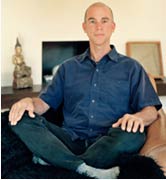
Jamie McHugh.
Photo by Rick Chapman.