|
||||||||||||||||
 |
 |
|
||||||||||||||
|
|
|||||||||||||||
|
“I am a biological process, a vital part of the mystery of Creation, not separate from it.” |
AIDS, Healing and the Politics of the Body
This was originally written for the 1996 invitational conference "Sida et l’acte artistique" in Paris, France. For the past twelve years, I have been HIV-positive and have explored various pathways for healing. My personal journey and professional work as a movement therapist and expressive arts educator have brought me into contact with innovative thinkers and theorists of the body, including Anna Halprin, Marjorie Barstow, Bonnie Bainbridge Cohen, Emilie Conrad-Da’oud and Dr. George Solomon, who have revolutionized my thinking and have helped me enlarge my views of the body, health and healing. Through these influences I have learned to appreciate and use the expressive power and somatic wisdom of my own body as my primary treatment modality. I am a biological process, a vital part of the mystery of Creation, not separate from it. By attending to my rhythms of activity and rest, expression and reflection, inhale and exhale, I come closer to my organismic self and learn, through the body, how to ultimately love and care for myself. Stress, somatic holding patterns, and fear isolate me from myself and others. Inhibition of movement and expression dulls my vibrancy and ultimately compromises my immunity. When I participate with my bodily self as collaborator rather than as dictator or slave, I cultivate optimal functioning and more vitality. All too often in Western culture the body is viewed as the object of our mind rather than as the subject of our heart. Our health care systems reflect a Cartesian philosophy, encouraging us to view the body as a machine. Many healing practices in Western culture, whether they are traditional or alternative, perpetuate a paradigm of objectification, dependency and consumerism. We are not taught how to have an “I-Thou” relationship with our bodies, one of intimacy and grace. Nor are we remotely educated to become our own primary healthcare providers. As a result, many of us feel powerless and estranged from our own physical process and, quite often, reliant upon a pill, a doctor or a "prescription for life" that comes from the outside. We have also been hypnotized by generations of dogma about the original sin of the body and the unworthiness of the flesh. To enter the experience of the bodily self with respect, curiosity and trust seems contrary to our spiritual traditions that often encourage us to be somewhat ascetic and favor suffering over pleasure, mind over sensation, and ideals over flesh. This culturally sanctioned split between body and spirit makes it challenging to reclaim the original grace of our being and live in the wholeness of our flesh. Sex is the major, and sometimes only, somatic and creative connection that many modern people know. Yet sex is usually surrounded by a cloud of shame and confusion. This shame obscures a wealth of sensate knowledge and deeply healing pleasure. AIDS demands we deal openly and directly with sexuality on all levels because our very lives are at stake. Our collective discomfort with bodily processes and sexual behavior is illuminated by the on-going political battle over attempts to disseminate explicit educational materials. We cannot continue, though, to limit the erotic to just the sexual arena. The erotic is an attitude towards our bodies, an aspect of a living aesthetic. The more we repress and prohibit the body's erotic nature, the more we isolate ourselves from the natural world and our place in it. Rebuilding and restoring body intimacy and an inner sensory aesthetic is vital for both prevention and treatment strategies in the age of AIDS. Webster’s defines heal as, to make sound or whole; to patch up; to restore to original purity or integrity. What many of us need to make whole is the unconscious negation of the organism, and its expression as a biological and erotic entity. This is even more essential when confronted with a disease process, where there is a tendency to flee from our bodies. The resulting avoidance of somatic cues and the repression of feeling states limits our ability to deal effectively with the illness. What is called for is to move in the opposite direction: to cultivate our ability to be self-referencing and self-actualizing by deepening our relationship with the body and attending to its information. I use movement as a form of primary somatic re-patterning and psychological re-parenting. Movement, sound and touch are pre-verbal languages that assist the brain in creating inner bodily coherence. My work also utilizes expressive movement as a form of Jungian “active imagination” to explore the images, dreams, feelings and beliefs of the personality. The more I can loosen the controls of the ego mindfully, the more access I have to the Mystery. As we are bound by our psychic tensions through the form of bodily tensions, cultivating more fluidity and expression also allows more freedom of the psyche. For the past eight years, I have worked with hundreds of people challenging disease - whether it be HIV, cancer, chronic pain or even spiritual malaise - in classes, workshops and individual sessions. I have found that somatic awareness and movement expression within a supportive and non-judgmental environment is a way to empower individuals in their own healing process. Our immune system is part of a larger matrix of relationship and communication that involves not only our physiology, but our psychology and our connection with others. The sessions are a laboratory for investigating non-ordinary states of perception and sensations mindfully. This is a way to interrupt habituation and create a fluid matrix for exploring creative possibilities; first, pre-verbally through the body, then secondarily, through a cognitive re-organization of behavior. As we broaden our repertoire of movement choices, we have the opportunity to envision more choices for action. I am postulating that mechanisms of communication in the body are enhanced and influenced through self-regulating somatic practices that increase the individual's sense of relationship internally and externally. Additionally, the act of creating meaning involves the expression of internal psychic states that, in turn, affect bodily processes and organization. Observationally, the somatic and the expressive can be linked to enhanced quality of life. But is it truly healing? And in what sense of the word? It will take many years to develop the research to fully understand the implications of this work on immune system response. In the meantime, somatic practitioners and artists can continue developing educational and therapeutic models of inclusion and participation that focus on increasing self-empowerment through expression, communication and relationship, intrapersonally and interpersonally. It is equally important that AIDS service agencies and the activist community begin to broaden their approach to, and advocacy of, treatment options for people living with HIV that include these somatic and expressive interventions. As a muralist friend of mine said at a public dedication many years ago, the more languages we have as people, the more power we have. Or, as the timely wisdom goes: don’t put all of your eggs in one basket. Thank you.
|
|
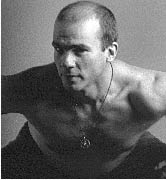
Jamie McHugh. |
|
||||||||||||
| © Copyright Jamie McHugh. All rights reserved. About Jamie | What Is Somatic Expression? | Courses | Calendar | Somatic Expression Articles | Somatic Expression Links | Products | Contact Jamie McHugh | Home |
||||||||||||||||